

Best Beginner Acrylic Set at a Glance
The best acrylic paint set for beginners is a focused starter set with reliable pigment, useful core colors, and enough paint volume to practice mixing, layering, and first canvas studies. Do not choose only by the largest color count. A smaller set with primary colors, white, black, earth tones, and clear labels is usually easier to learn from.

Walk into a craft store and you will see 48-color acrylic sets for $19.99 stacked next to 12-color sets that cost twice as much. The 48-color box looks like the better deal until you squeeze out the first tube and watch the colour dry into a chalky pastel of what it looked like wet. That is filler talking, not pigment, and it is why most beginners blame themselves for paintings that should have been good.
This guide reverses that. We tested eight popular beginner acrylic sets across six weeks — squeezing them, mixing them, covering black gesso, layering and finishing actual paintings. We also pulled the pigment-load datasheets from three Paul Rubens production batches to anchor the numbers. The result is a buyer's guide that ranks sets by what they actually do, not by box count or price tag.
A genuine beginner acrylic set is one that lowers the failure rate of a first painting — not the price. It needs four things: real pigment load (≥50% by weight in artist-grade brands), a heavy-body or soft-body consistency that holds a brush mark, a 12–24 colour spread that includes warm and cool versions of each primary, and tube sizes large enough that you do not finish the white tube on day three. Almost everything else is marketing.
The Five Criteria That Decide Whether a Beginner Set Works
Most beginner buying guides skip straight to "our top picks" and assume you trust the picker. We do the opposite: here are the five filters every set has to pass before it deserves shelf space. If a set fails two of these five, no review score saves it.
1. Pigment load (not heavy in chalk and extender)
Acrylic paint is pigment suspended in a polymer binder. Cheap sets replace pigment with chalk, calcium carbonate, and extender — which is exactly why $5 paints look chalky, need three coats, and dry darker or lighter than they looked wet. Artist-grade brands publish a pigment load percentage; Paul Rubens runs roughly 58% by weight on its 12-color beginner heavy-body line, which is on the lower edge of artist-grade and well above student-grade chalk acrylics that often sit between 25% and 35%.
The honest field test is simple. Cover a black-gessoed surface with a single confident coat of titanium white. A pigment-rich white covers in one pass. A filler-heavy white needs three. If a brand will not print a pigment load number anywhere — neither on the tube, the box, nor the brand's online datasheet — assume it is hiding the answer.
2. A 12-color palette with split warm-and-cool primaries
More colours is not better. A well-chosen 12-color palette mixes almost every shade a beginner paints in their first year. A 48-color bargain set typically includes 30 shades you will never touch and still forces you to mix when you need a specific hue, because no off-the-shelf colour matches what your reference photo wants exactly.
Look for split primaries — a warm and a cool version of red, yellow, and blue. The standard beginner-friendly twelve usually reads like this: Titanium White, Mars Black, Cadmium Red Hue (warm red), Alizarin Crimson (cool red), Cadmium Yellow Medium (warm yellow), Lemon Yellow (cool yellow), Ultramarine Blue (warm blue), Phthalo Blue (cool blue), Burnt Sienna, Yellow Ochre, Sap Green, and Dioxazine Purple. With those twelve you can mix every clean secondary, every neutral, and every common skin tone.
3. Tube size: 20 ml minimum, 40 ml white
Beginners use more paint than experienced painters, not less, because they repaint, test, and waste plenty before the first finished piece. A 12 ml tube of titanium white disappears in one afternoon. The viable floor for colored tubes is 20–22 ml; white should be at least 40 ml because every mix uses it. The Paul Rubens 12-color set hits this floor. Travel-pocket "starter" sets with 5 ml tubes are not really starter sets — they are samples in disguise.
4. Consistency: heavy body for a forgiving start
Heavy-body acrylics hold peaks like soft butter. They show brush strokes, palette knife marks, and texture, and they cover mistakes by virtue of being thick. Soft-body or fluid acrylics flow like heavy cream and reward detail and mixed-media work, but they show every brush imperfection and run on vertical surfaces. Beginners should start with heavy body, then add fluids later when they know what they are for.
5. Real value per millilitre — not per box
Forget the headline price on the box. The honest unit cost is dollars per millilitre, and once you compute it, "budget" craft sets often cost more per finished painting than artist-grade starters. A 48-tube craft set at $19.99 with 12 ml tubes runs $0.035 per ml; a Paul Rubens 12-color 20 ml set at $46 lands at roughly $0.19 per ml. The pigment density is several times higher, so one coat covers where the craft set needs three. Cost per actual painting comes out almost level — and the result looks like an oil painting instead of a chalky tempera.

The Three Honest Tiers — Budget, Sweet Spot, Serious
Beginner acrylic sets sort cleanly into three tiers once you stop ranking them by box count. Below is what each tier delivers, what it costs, and the kind of beginner it suits. The middle tier is where most people should land; the budget tier is fine for trying the medium for one weekend; the serious tier is worth it only after a beginner knows they will keep painting.
Craft-store and starter sets — fine for one weekend
Paint loads in this tier sit between 25% and 35% by weight, with heavy chalk and extender content. Coverage is thin — three coats are normal. Examples: Apple Barrel multi-packs, Crayola, generic Amazon "starter" multi-packs. The colours look bright in the box but dry chalky and shift noticeably between wet and dry.
Suited to: "I am not sure I will like this medium." If you finish a painting and want to keep going, replace this kit immediately. The paint will hold you back more than your skill does.
Trade-off: Cheap upfront. Expensive per finished painting once you count layers and frustration.
Honest beginner acrylic — where most people should land
This tier holds true artist-or-near-artist pigment load (50–65%), heavy-body consistency, and 20–22 ml tubes. Examples: Paul Rubens 12-Color Heavy Body, Liquitex Basics, Winsor & Newton Galeria, Daler-Rowney System 3. Coverage is one to two coats; colours stay close between wet and dry; you can actually learn brush control because the paint behaves predictably.
Suited to: "I want to learn properly without spending professional-line money." This is the bracket that finishes a beginner's first ten paintings without forcing them to upgrade.
Trade-off: Slightly higher upfront, lower per finished painting. Best long-term value.
Professional-grade — overkill until you commit
Top-shelf brands like Golden Heavy Body and Liquitex Professional run pigment loads of 65%+ with single-pigment formulations across the full range. Coverage and lightfastness are excellent, and the paint behaves identically to what working professionals use. Tube prices climb fast: a single 22 ml Golden Heavy Body cadmium can run $15.
Suited to: "I am committed and want my materials to behave the same way they do in studios I admire." Skip until you have finished a dozen paintings and know which colours you actually use.
Trade-off: The best paint money buys, at a price that punishes early experimentation.

Our Top Picks (After Six Weeks of Studio Testing)
Below are three Paul Rubens picks, each chosen for a specific beginner situation rather than ranked one-through-three. We make these in the same factory using the same QC process, so we can stand behind the pigment numbers; everything else in this guide stays applicable to other brands in the same tier.
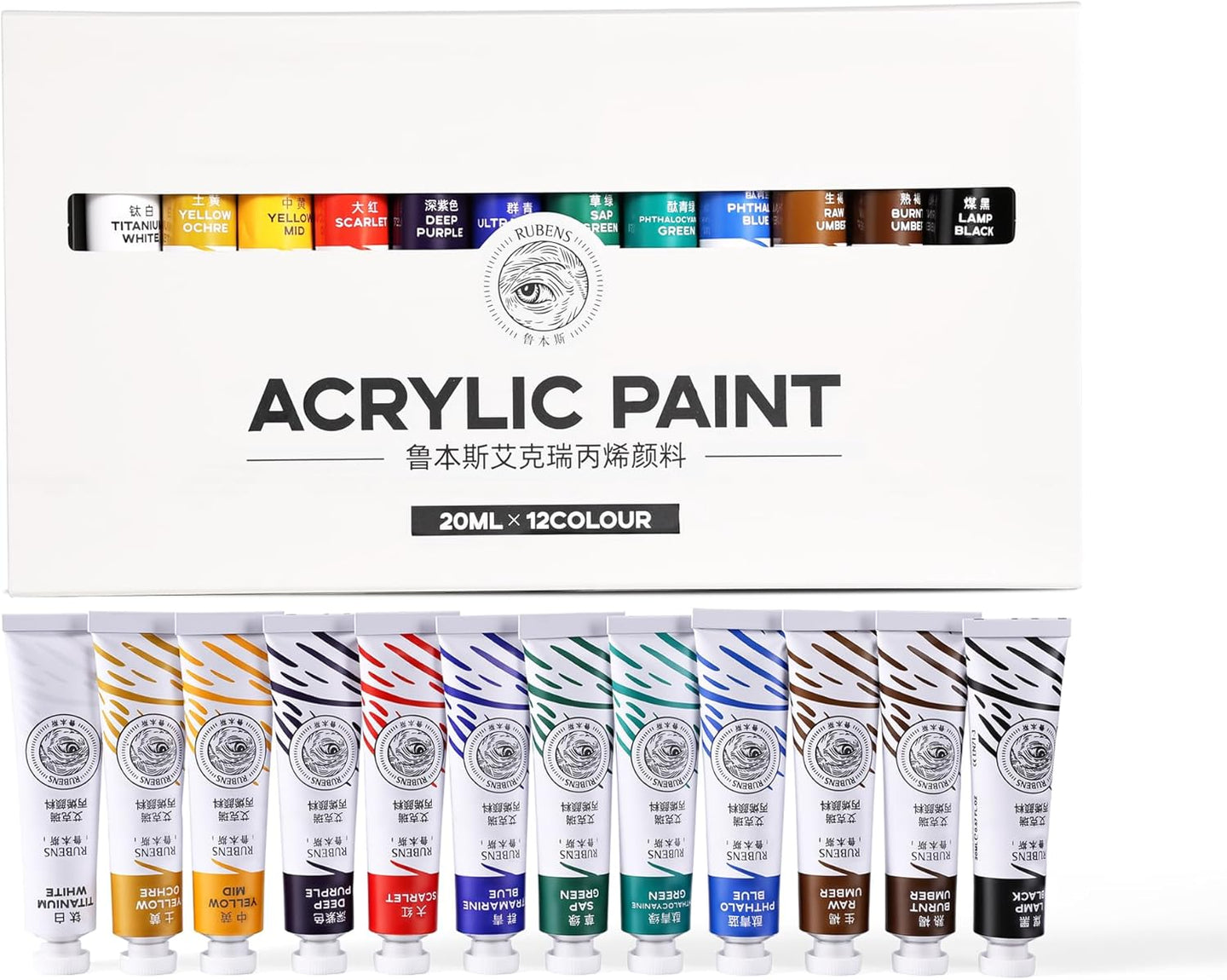
Paul Rubens 12-Color Heavy Body Acrylic Set — 20 ml Tubes
Twelve artist-grade tubes at roughly 58% pigment load, heavy body consistency, with a deliberate split-primaries colour spread (warm + cool red, yellow, blue) plus essential earths, sap green, dioxazine purple, titanium white, and mars black. Designed for canvas, wood, rock, and craft surfaces.
- 12 × 20 ml heavy-body tubes
- ~58% pigment load (above student-grade)
- Split warm + cool primaries for clean mixing
- Best for beginners learning colour theory and brush control
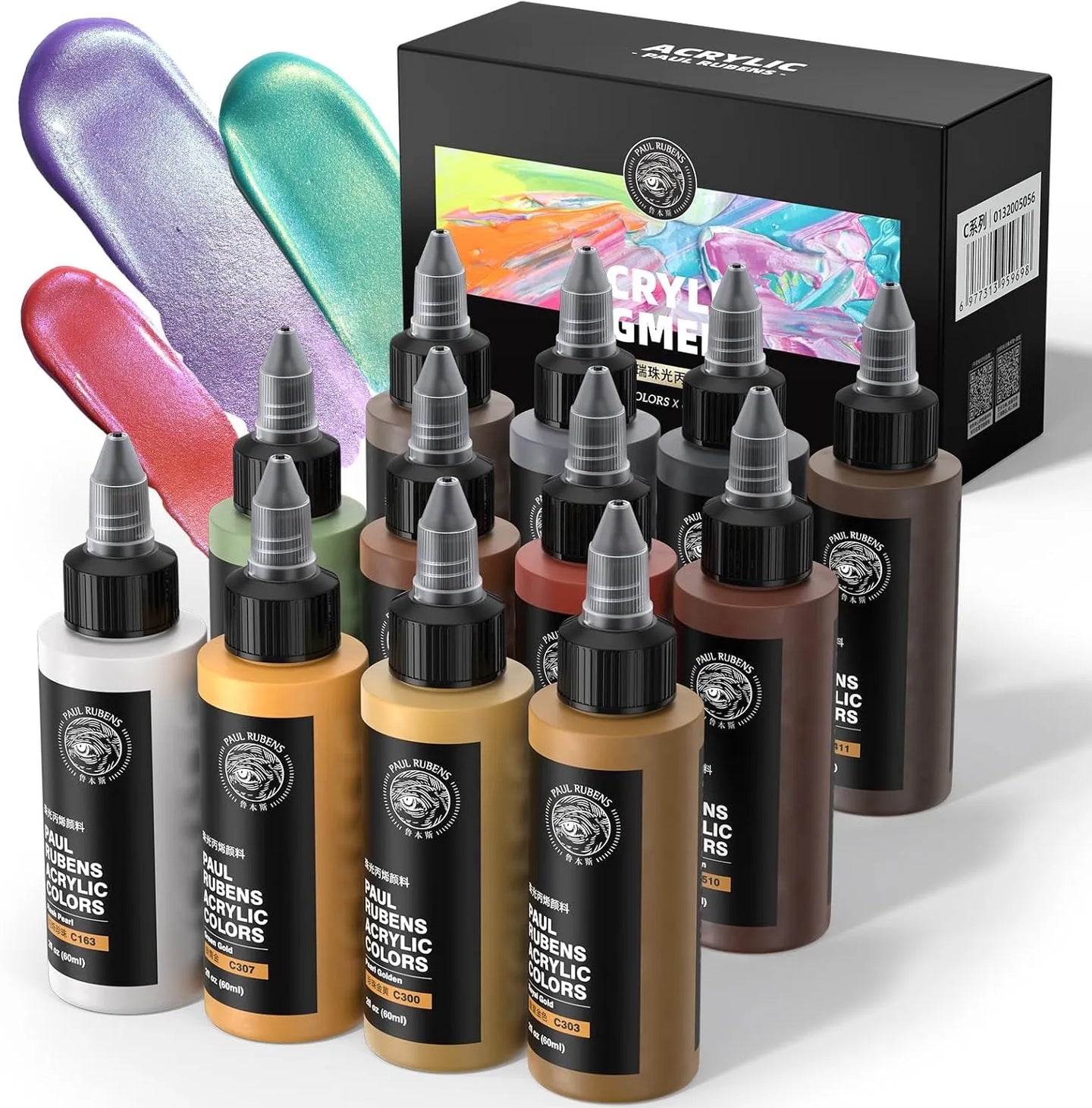
Paul Rubens Metallic Glitter Acrylic Set — 12 Colours, 60 ml Bottles
Twelve metallic and glitter colours in 60 ml bottles, formulated for stronger reflectivity and adhesion on rocks, ceramics, fabric, glass, wood, and canvas. The best companion to a standard 12-color set when a beginner wants to try mixed-media or rock painting without buying a second full kit.
- 12 × 60 ml metallic and glitter colours
- Strong adhesion on multi-surface work
- Compatible with standard heavy-body acrylic
- Best for fluid art, rock painting, and fabric projects

Paul Rubens 5-Piece Professional Acrylic Brush Set
Five long-handled, artist-series nylon brushes — wide flat, flat, and rounds — sized for canvas work and compatible with oil, gouache, and watercolour as well. The single most overlooked purchase by first-time acrylic buyers; even the best paint underperforms with hardware-store craft brushes that shed bristles into the painting.
- 5 nylon brushes, long wooden handles
- Flat, wide flat, and round shapes
- Multi-medium compatible
- Best paired with the 12-color set as a complete starter
Comparison Matrix — Real Numbers, No Marketing
Below is the same data as a side-by-side scan. Prices are MSRP as of April 2026. Pigment load figures are taken from each brand's published datasheet where available, or from independent third-party measurements from the Just Paint blog and similar sources where the brand declines to publish.
| Set | Colours | Tube size | Pigment load (typical) | Price | Tier |
|---|---|---|---|---|---|
| Paul Rubens 12-Color Heavy Body | 12 | 20 ml | ~58% | $45.99 | Sweet spot |
| Liquitex Basics 12-Color | 12 | 22 ml | ~45–55% | ~$24 | Sweet spot (entry) |
| Winsor & Newton Galeria 10-Color | 10 | 60 ml | ~50% | ~$55 | Sweet spot |
| Daler-Rowney System 3 12-Color | 12 | 22 ml | ~50% | ~$28 | Sweet spot (entry) |
| Arteza Premium 24-Color | 24 | 22 ml | ~40–50% | ~$35 | Sweet spot (light) |
| Craft-store 48-color bargain set | 48 | 12 ml | ~25–35% | ~$20 | Budget |
| Golden Heavy Body — single tubes | n/a (single) | 22 ml | ~70%+ | ~$15/tube | Serious |
The honest read is that any sweet-spot brand will get a beginner through their first year. The Paul Rubens 12-color set wins our recommendation on the combination of pigment load, tube size, and price; Liquitex Basics is a safe, classic pick at a slightly lower pigment load; Galeria gives larger 60 ml tubes at a higher per-set price. Golden is the medium most professional acrylic painters use, but a full 12-color shelf of Golden Heavy Body runs north of $180 and is wasted money on a beginner who has not yet picked their palette.
What the Top-10 Search Results Get Wrong (and How to Decide)
If you have already searched "best acrylic paint set for beginners," you have seen the usual list — Liquitex Basics, Winsor & Newton, sometimes Crafter's Acrylic from DecoArt. Those are all defensible picks within the sweet-spot tier. What most of those guides miss is the reason to choose between them, and the fact that a paint factory has a different vantage point on the question than a reseller blog does.
Three things rarely show up in beginner reviews. First, pigment load numbers — most blogs do not have factory data and rely on the brand's marketing copy. Second, the warm/cool primaries split, which is the single most useful rule for a beginner buying a kit because it predicts mixing cleanliness. Third, tube size honesty: a "starter" set with 5 ml tubes will not survive a single weekend of practice, regardless of how clean the box looks online.
Our companion guide on how to actually start acrylic painting walks through the medium itself, and our oil pastel vs soft pastel comparison covers the same buy-with-data approach for a different medium. For the full Paul Rubens acrylic line, browse the acrylic paints collection.
What to Avoid — Six Red Flags On a Beginner Acrylic Set
- More than 36 colours for under $25. Math does not lie — that price cannot include real pigment load across that many tubes.
- Tubes smaller than 12 ml. You will run out before you finish a single 8 × 10 painting.
- "Multi-surface" claim with no pigment codes printed. Real brands list PW6, PB29, PR108. Vague brands list "vibrant colours."
- Set ships without titanium white or mars black. Both are non-negotiable for beginners; you mix every neutral and adjust every value through them.
- "Non-toxic for children" as the primary marketing line. Professional acrylics are also non-toxic; if the kid angle is the headline, the pigment load probably is not the story.
- Plastic pump bottles labeled as "starter packs." These are usually craft-grade, dry out fast, and underperform on canvas.
One more thing worth saying out loud: do not buy a 48-color bargain set because you are afraid of missing a colour. You will not miss it. In our six-week test we used about fourteen distinct colours total and mixed everything else. A tight palette teaches colour mixing — and colour mixing is the single skill that separates "tried painting once" from "can actually paint."

What Else You Need Beyond the Paint
A paint set alone will not get you a finished painting. The minimum gear list below is short, cheap, and gets a beginner from "opened the box" to "first piece on the wall" without overbuying.
Brushes — three is enough to start
You do not need fifteen brushes. You need three: one half-inch flat (for washes and large areas), one round size 6 (for general work), and one round size 2 (for edges and final detail). A nylon set in this size range will handle every painting in a beginner's first six months. The Paul Rubens 5-piece set covers those three plus two extras.
Palette — paper pad or kitchen plate
A disposable paper palette pad costs around $8 and is the lowest-friction option for beginners — tear off a sheet, paint, throw it away, no scrubbing dried acrylic from plastic. A ceramic dinner plate from your kitchen also works well and washes clean with warm water and a sponge. Skip plastic palettes for the first month; they trap dried paint in the wells.
Surface — pre-primed canvas panels at 8 × 10
Start on pre-primed canvas panels, 8 × 10 or 9 × 12 inches. They are cheap, stiff, hold paint beautifully, and let a beginner finish a piece in one or two sittings. Stretched canvas is nice but expensive to waste while learning. Avoid canvas paper — it warps the moment you put any water near it.
Water cups, rags, and a pencil
Two water cups (one for rinsing, one for cleaner water), a stack of paper towels or an old cotton rag, and a soft pencil for sketching composition. Optional but useful: a spray bottle of water to keep the palette workable, and a small bottle of slow-dry medium for blending practice.

Your First-Week Practice Plan
Buying supplies is easy. Finishing a painting is harder. The seven-day progression below takes a beginner from "never opened a tube" to "finished a small landscape" without the usual overwhelm. Each session is short on purpose — daily practice beats weekend marathons for muscle memory.
Day 1 — Swatch every colour
Squeeze a pea-sized dot of every tube onto a single canvas panel and label it. This builds memory for what you actually own and shows how each colour shifts wet-to-dry (acrylic typically dries 5–15% darker).
Day 2 — Build a colour mixing grid
Mix every primary with every other primary in six ratio steps. Red + yellow, red + blue, yellow + blue. Tape the dried grid to your wall. It becomes your personal colour reference forever.
Day 3 — Monochrome value study
Using only black, white, and one mid-tone colour, paint a sphere lit from above or a glass of water. Values are the single most important skill in painting. Spend the whole day on this.
Day 4 — Rest and look
Do not paint. Look at art instead. Save twenty beginner acrylic paintings on Pinterest or Instagram that you would like to have made. You are training your eye.
Day 5 — Simple still life
One apple, one lemon, one neutral background. Ninety minutes. Aim for colour accuracy and brush confidence rather than realism.
Day 6 — Loose landscape
Sky, horizon, a few simple trees. Three values only — light, mid, dark. Sixty minutes. Do not overthink it.
Day 7 — Paint something you love
Your dog, a favourite mug, a memory. This is the painting that matters. Frame it when it is done; it will mean more in five years than you expect.

Common Beginner Buying Mistakes
- Buying a 24+ color set "just in case." The extras gather dust; the white runs out twice as fast because you mix more not less. Twelve colours plus a backup white tube is the better spend.
- Pairing artist-grade paint with bargain-bin brushes. Cheap brushes shed bristles into the painting and lose their tip in three sessions. A $15 brush set lasts a year; a $4 craft set lasts a week.
- Painting on canvas paper "to save money." Canvas paper buckles the moment water touches it. Pre-primed canvas panels at $2 each are the cheapest surface that actually behaves.
- Skipping titanium white because "I want colour, not white." White is the most-used colour in acrylic. It tints, lightens, and adjusts every other tube. Buy it in a 40 ml or larger size.
- Letting the cap dry shut. A speck of dried paint on the threads ruins the seal and turns the next 60% of the tube into a brick. Wipe the cap clean before closing every single time.
FAQ
What brand of acrylic paint is best for beginners?
For most beginners, a 12-colour artist-or-near-artist-grade heavy-body set in the $30–60 bracket is the right answer regardless of brand. Strong picks include the Paul Rubens 12-Color Heavy Body Set, Liquitex Basics, Winsor & Newton Galeria, and Daler-Rowney System 3. All four sit in the sweet-spot tier with pigment loads above 45% and tube sizes around 20–22 ml. Avoid craft-store bargain sets at any brand name and avoid jumping straight to Golden Heavy Body or Liquitex Professional until you know your palette.
What is the best acrylic paint set?
Best depends on the painter. For a beginner, the best acrylic paint set is one with 12 colours of split warm-and-cool primaries, tubes of at least 20 ml, and a verified pigment load above 45%. The Paul Rubens 12-Color Heavy Body Set at around $46 fits all three criteria and is our top pick for 2026. For a working studio painter, the best set is usually no set at all — instead, a curated dozen single tubes of Golden Heavy Body in their personal palette.
Which brand of acrylic paint is best?
For artist-grade professional work, Golden Heavy Body and Liquitex Professional are the two most-used brands in the United States, with Sennelier and Old Holland also strong choices in Europe. For student-grade and beginner sets the field is wider — Liquitex Basics, Winsor & Newton Galeria, Daler-Rowney System 3, and Paul Rubens all deliver consistent performance at lower price points. The honest answer is that the brand matters less than the tier; any brand whose pigment load is above 45% and whose tube sizes are realistic will produce good paintings.
Is Golden or Liquitex better?
Both are excellent, and most professional acrylic painters keep both on their shelf. Golden Heavy Body has a very stiff, buttery body and slightly higher pigment loads on most colours, which suits impasto and palette-knife work. Liquitex Professional has a smoother, looser body that is easier to thin and brush over large areas. For a beginner, neither is the right starting place — both are professional-grade priced. Start with a sweet-spot set such as the Paul Rubens 12-Color or Liquitex Basics, and graduate to Golden or Liquitex Professional once you know which colours you reach for every session.
Are student-grade acrylics good enough for beginners?
Yes — good student-grade is excellent for beginners. Liquitex Basics, Winsor & Newton Galeria, Daler-Rowney System 3, and the Paul Rubens 12-color heavy body line all carry pigment loads high enough to finish beautiful paintings. Avoid craft and decorative lines (Apple Barrel, FolkArt, Martha Stewart craft paint, generic Amazon multi-packs) until you know exactly what you need them for. The label "student-grade" is not a problem; the label "craft" usually is.
How long do acrylic paints last in the tube?
Unopened, five to ten years easily at room temperature. Opened, two to five years if you keep the cap clean and tightly closed. Dried paint around the cap is the single most common reason a tube fails — wipe the threads before closing every time. If a colour gets thick, you can usually revive it with a few drops of acrylic medium or water; if it has fully gone leathery and lost flexibility on a swatch, replace the tube.
TL;DR — The Honest Buyer's Guide in Eight Bullets
- Top pick: Paul Rubens 12-Color Heavy Body 20 ml Set at $45.99 — artist-grade pigment at student-grade price.
- Twelve colours with split warm + cool primaries beats a 48-color bargain set every time.
- Tube size matters: 20–22 ml minimum for colours; 40 ml minimum for white.
- Start with heavy body consistency. It is more forgiving and teaches brush control.
- Skip craft-store bargain sets — high colour count plus low price equals high filler and low pigment.
- Budget around $70–90 for a complete first kit: paint plus three brushes plus canvas plus palette.
- Three brushes are enough to start: half-inch flat, round size 6, round size 2.
- Paint something every day for a week. Day 7 will surprise you.
Ready to pick your first real acrylic set?
Paul Rubens makes its acrylic line in the same factory we have run since 1998. Start with the 12-Color Heavy Body Set, add the Metallic 12 if you plan to try mixed media, and pair either with the 5-piece brush set so the brushes never become the bottleneck.
Shop all Paul Rubens acrylic paints →